 dcc.DatePickerRange
dcc.DatePickerRange is a component for rendering calendars from which users can select a range of dates.
You can use either strings in the form YYYY-MM-DD or date objects from the datetime module to provide dates to Dash components. Strings are preferred because that’s the form dates take as callback arguments. If you are using date objects, we recommend using datetime.date so there is no time part. dcc.DatePickerRange accepts dates with a time part, but this can be confusing, particularly for the initial call of a callback. After the user chooses a new date, there will be no time part—only the date. If you already have a datetime.datetime object, you can convert it with date().
Month and Display Format
The month_format property determines how calendar headers are displayed when the calendar is opened.
The display_format property determines how selected dates are displayed in the dcc.DatePickerRange component.
Both of these properties are configured through strings that use a combination of any of the following tokens.
| String Token | Example | Description |
|---|---|---|
YYYY |
2014 |
4 or 2 digit year |
YY |
14 |
2 digit year |
Y |
-25 |
Year with any number of digits and sign |
Q |
1..4 |
Quarter of year. Sets month to first month in quarter. |
M MM |
1..12 |
Month number |
MMM MMMM |
Jan..December |
Month name |
D DD |
1..31 |
Day of month |
Do |
1st..31st |
Day of month with ordinal |
| DDD DDDD | 1..365 |
Day of year |
X |
1410715640.579 |
Unix timestamp |
x |
1410715640579 |
Unix ms timestamp |
Examples
Find a few usage examples below.
For more examples of minimal Dash apps that use dcc.DatePickerRange, go to the community-driven Example Index.
Simple DatePickerRange Example
This is a simple example of a dcc.DatePickerRange component tied to a callback.
The min_date_allowed and max_date_allowed properties define the minimum and maximum selectable dates on the calendar while initial_visible_month defines the calendar month that is first displayed when the dcc.DatePickerRange component is opened.
from datetime import date
from dash import Dash, dcc, html, Input, Output, callback

app = Dash()
app.layout = html.Div([
    dcc.DatePickerRange(
        id='my-date-picker-range',
        min_date_allowed=date(1995, 8, 5),
        max_date_allowed=date(2017, 9, 19),
        initial_visible_month=date(2017, 8, 5),
        end_date=date(2017, 8, 25)
    ),
    html.Div(id='output-container-date-picker-range')
])


@callback(
    Output('output-container-date-picker-range', 'children'),
    Input('my-date-picker-range', 'start_date'),
    Input('my-date-picker-range', 'end_date'))
def update_output(start_date, end_date):
    string_prefix = 'You have selected: '
    if start_date is not None:
        start_date_object = date.fromisoformat(start_date)
        start_date_string = start_date_object.strftime('%B %d, %Y')
        string_prefix = string_prefix + 'Start Date: ' + start_date_string + ' | '
    if end_date is not None:
        end_date_object = date.fromisoformat(end_date)
        end_date_string = end_date_object.strftime('%B %d, %Y')
        string_prefix = string_prefix + 'End Date: ' + end_date_string
    if len(string_prefix) == len('You have selected: '):
        return 'Select a date to see it displayed here'
    else:
        return string_prefix


if __name__ == '__main__':
    app.run(debug=True)
Month Format Examples
You can set month_format to any permutation of the string tokens shown in Month and Display Format above to change how calendar titles are displayed in the dcc.DatePickerRange component.
from dash import dcc
from datetime import date

dcc.DatePickerRange(
    month_format='MMM Do, YY',
    end_date_placeholder_text='MMM Do, YY',
    start_date=date(2017, 6, 21)
)
from dash import dcc
from datetime import date

dcc.DatePickerRange(
    month_format='M-D-Y-Q',
    end_date_placeholder_text='M-D-Y-Q',
    start_date=date(2017, 6, 21)
)
from dash import dcc
from datetime import date

dcc.DatePickerRange(
    month_format='MMMM Y',
    end_date_placeholder_text='MMMM Y',
    start_date=date(2017, 6, 21)
)
from dash import dcc
from datetime import date

dcc.DatePickerRange(
    month_format='X',
    end_date_placeholder_text='X',
    start_date=date(2017, 6, 21)
)
Display Format Examples
You can use any permutation of the string tokens shown in Month and Display Format above to change how selected dates are displayed in the dcc.DatePickerRange component.
from dash import dcc
from datetime import date

dcc.DatePickerRange(
    end_date=date(2017, 6, 21),
    display_format='MMM Do, YY',
    start_date_placeholder_text='MMM Do, YY'
)
from dash import dcc
from datetime import date

dcc.DatePickerRange(
    end_date=date(2017, 6, 21),
    display_format='M-D-Y-Q',
    start_date_placeholder_text='M-D-Y-Q'
)
from dash import dcc
from datetime import date

dcc.DatePickerRange(
    end_date=date(2017, 6, 21),
    display_format='MMMM Y, DD',
    start_date_placeholder_text='MMMM Y, DD'
)
from dash import dcc
from datetime import date

dcc.DatePickerRange(
    end_date=date(2017, 6, 21),
    display_format='X',
    start_date_placeholder_text='X'
)
Vertical Calendar and Placeholder Text
The dcc.DatePickerRange component can be rendered in two orientations, either horizontally or vertically. If calendar_orientation is set to 'vertical', it will be rendered vertically and will default to 'horizontal' if not defined.
start_date_placeholder_text and end_date_placeholder_text define the grey default text defined in the calendar input boxes when no date is selected.
from dash import dcc

dcc.DatePickerRange(
    start_date_placeholder_text="Start Period",
    end_date_placeholder_text="End Period",
    calendar_orientation='vertical',
)
Minimum Nights, Calendar Clear, and Portals
The minimum_nights property defines the number of nights that must be in between the range of two selected dates.
When the clearable property is set to True, the dcc.DatePickerRange renders with a small ‘x’ that the user can select to remove selected dates.
The dcc.DatePickerRange component supports two different portal types, one being a full screen portal (with_full_screen_portal) and another being a simple screen overlay, like the one shown below (with_portal).
from dash import dcc
from datetime import date

dcc.DatePickerRange(
    minimum_nights=5,
    clearable=True,
    with_portal=True,
    start_date=date(2017, 6, 21)
)
Right to Left Calendars and First Day of Week
When the is_RTL property is set to True the calendar will be rendered from right to left.
The first_day_of_week property allows you to define which day of the week will be set as the first day of the week. In the example below, Tuesday is the first day of the week.
from dash import dcc
from datetime import date

dcc.DatePickerRange(
    is_RTL=True,
    first_day_of_week=3,
    start_date=date(2017, 6, 21)
)
Calendar Translations
New in Dash 4.0
You can change the calendar language by adding a date-fns translations script using external_scripts on the Dash app constructor or by adding the script to the assets folder. The following example adds the French translation.
from dash import Dash, dcc, html
from datetime import datetime

external_scripts = [
    'https://cdn.jsdelivr.net/npm/date-fns@4.1.0/locale/fr/cdn.min.js'
]

app = Dash(__name__, external_scripts=external_scripts)

app.layout = html.Div([
    dcc.DatePickerRange(
        start_date=datetime(2024, 1, 1),
        end_date=datetime(2024, 1, 15)
    )
])

if __name__ == '__main__':
    app.run(debug=True)
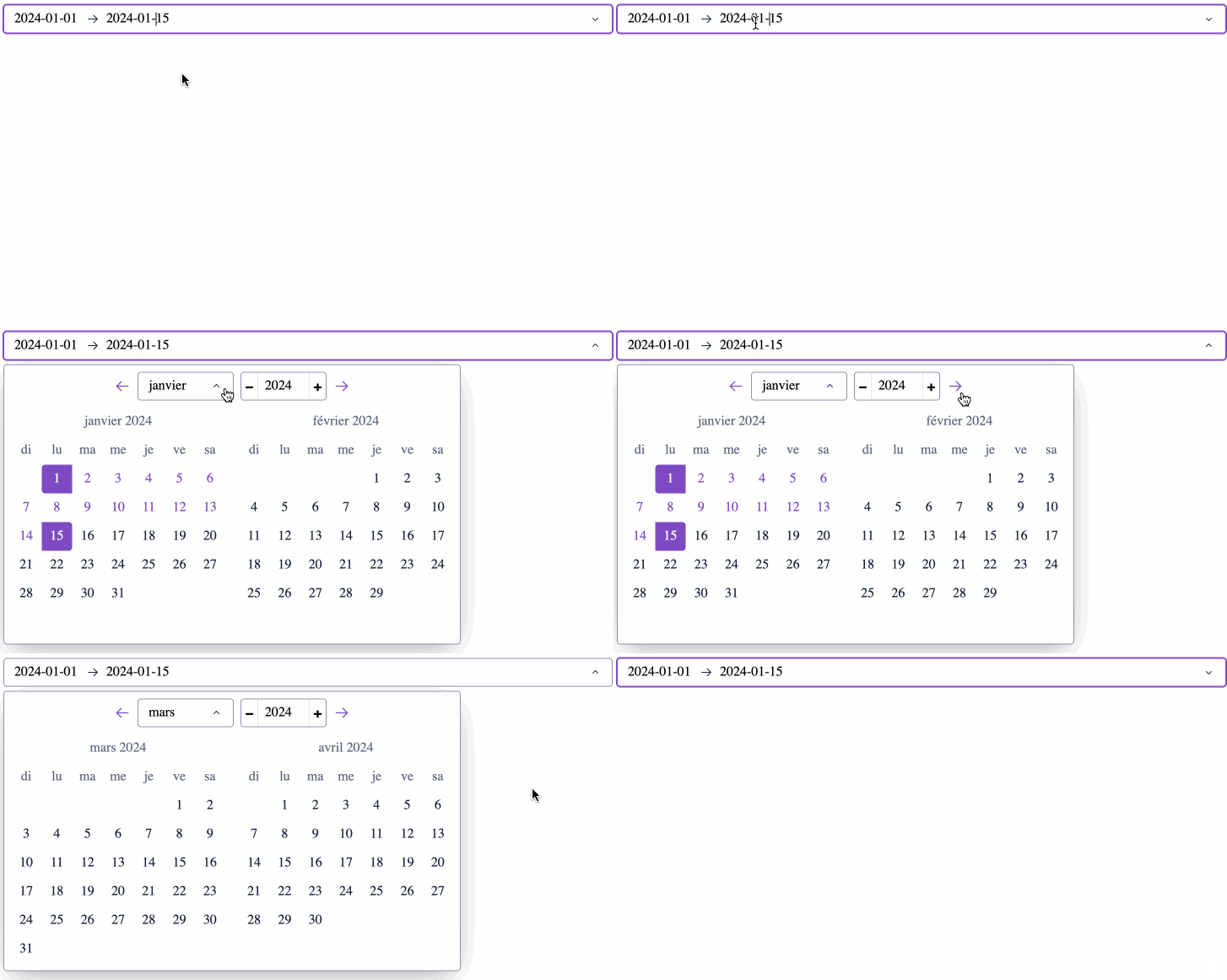
Language Matching
The DatePickerRange component matches the supplied translations with the app user’s browser language:
- If you include just one translation, all app users see that language. For example, the earlier example includes just French translations, so all app users will see a French calendar.
- If you include multiple translations, the first language provided is the one app users will see, unless that user’s preferred browser language is one of the other included languages. For example, if the app includes:
external_scripts = [
      'https://cdn.jsdelivr.net/npm/date-fns@4.1.0/locale/fr/cdn.min.js',
      'https://cdn.jsdelivr.net/npm/date-fns@4.1.0/locale/en/cdn.min.js'
  ]
all app users will see a French calendar except those whose preferred browser language is English.
- If you include no translations, all app users see English (the default).
See the date-fns CDN documentation on GitHub for more information and the locale directory for available locales.
You can also include all language translations instead of scripts for specific ones using the following script: https://cdnjs.cloudflare.com/ajax/libs/date-fns/4.1.0/locale/cdn.min.js.
DatePickerRange Properties
Access this documentation in your Python terminal with:
```pythonhelp(dash.dcc.DatePickerRange)
```
Our recommended IDE for writing Dash apps is Dash Enterprise’s
Data Science Workspaces,
which has typeahead support for Dash Component Properties.
Find out if your company is using
Dash Enterprise.
start_date (boolean | number | string | list | dict; optional):
Specifies the starting date for the component. Accepts
datetime.datetime objects or strings in the format ‘YYYY-MM-DD’.
end_date (boolean | number | string | list | dict; optional):
Specifies the ending date for the component. Accepts datetime.datetime
objects or strings in the format ‘YYYY-MM-DD’.
minimum_nights (number; optional):
Specifies a minimum number of nights that must be selected between the
startDate and the endDate.
updatemode (a value equal to: None, ‘singledate’ or ‘bothdates’; default 'singledate'):
Determines when the component should update its value. If bothdates,
then the DatePicker will only trigger its value when the user has
finished picking both dates. If singledate, then the DatePicker will
update its value as one date is picked.
start_date_placeholder_text (string; optional):
Text that will be displayed in the first input box of the date picker
when no date is selected. Default value is ‘Start Date’.
end_date_placeholder_text (string; optional):
Text that will be displayed in the second input box of the date picker
when no date is selected. Default value is ‘End Date’.
start_date_id (string; optional):
The HTML element ID of the start date input field. Not used by Dash,
only by CSS.
end_date_id (string; optional):
The HTML element ID of the end date input field. Not used by Dash,
only by CSS.
id (string; optional):
The ID of this component, used to identify dash components in
callbacks. The ID needs to be unique across all of the components in
an app.
componentPath (boolean | number | string | list | dict; optional)
className (string; optional):
Additional CSS class for the root DOM node.
persistence (string | number | boolean; optional):
Used to allow user interactions in this component to be persisted when
the component - or the page - is refreshed. If persisted is truthy
and hasn’t changed from its previous value, a value that the user
has changed while using the app will keep that change, as long as the
new value also matches what was given originally. Used in
conjunction with persistence_type.
persisted_props (boolean | number | string | list | dict; default [PersistedProps.start_date, PersistedProps.end_date]):
Properties whose user interactions will persist after refreshing the
component or the page. Since only value is allowed this prop can
normally be ignored.
persistence_type (a value equal to: None, ‘local’, ‘session’ or ‘memory’; default PersistenceTypes.local):
Where persisted user changes will be stored: memory: only kept in
memory, reset on page refresh. local: window.localStorage, data is
kept after the browser quit. session: window.sessionStorage, data is
cleared once the browser quit.
disabled (boolean; default False):
If True, no dates can be selected.
style (boolean | number | string | list | dict; optional):
CSS styles appended to wrapper div.
min_date_allowed (string; optional):
Specifies the lowest selectable date for the component. Accepts
datetime.datetime objects or strings in the format ‘YYYY-MM-DD’.
max_date_allowed (string; optional):
Specifies the highest selectable date for the component. Accepts
datetime.datetime objects or strings in the format ‘YYYY-MM-DD’.
disabled_days (list of strings; optional):
Specifies additional days between min_date_allowed and
max_date_allowed that should be disabled. Accepted datetime.datetime
objects or strings in the format ‘YYYY-MM-DD’.
placeholder (string; optional):
Text that will be displayed in the input box of the date picker when
no date is selected.
initial_visible_month (string; optional):
Specifies the month that is initially presented when the user opens
the calendar. Accepts datetime.datetime objects or strings in the
format ‘YYYY-MM-DD’.
clearable (boolean; default False):
Whether or not the dropdown is “clearable”, that is, whether or not a
small “x” appears on the right of the dropdown that removes the
selected value.
reopen_calendar_on_clear (boolean; default False):
If True, the calendar will automatically open when cleared.
display_format (string; optional):
Specifies the format that the selected dates will be displayed valid
formats are variations of “MM YY DD”. For example: “MM YY DD” renders
as ‘05 10 97’ for May 10th 1997 “MMMM, YY” renders as ‘May, 1997’ for
May 10th 1997 “M, D, YYYY” renders as ‘07, 10, 1997’ for September
10th 1997 “MMMM” renders as ‘May’ for May 10 1997.
month_format (string; optional):
Specifies the format that the month will be displayed in the calendar,
valid formats are variations of “MM YY”. For example: “MM YY” renders
as ‘05 97’ for May 1997 “MMMM, YYYY” renders as ‘May, 1997’ for May
1997 “MMM, YY” renders as ‘Sep, 97’ for September 1997.
first_day_of_week (a value equal to: None, 0, 1, 2, 3, 4, 5 or 6; default 0):
Specifies what day is the first day of the week, values must be from
[0, …, 6] with 0 denoting Sunday and 6 denoting Saturday.
show_outside_days (boolean; default False):
If True the calendar will display days that rollover into the next
month.
stay_open_on_select (boolean; default False):
If True the calendar will not close when the user has selected a value
and will wait until the user clicks off the calendar.
calendar_orientation (a value equal to: None, ‘vertical’ or ‘horizontal’; default 'horizontal'):
Orientation of calendar, either vertical or horizontal. Valid options
are ‘vertical’ or ‘horizontal’.
number_of_months_shown (number; default 2):
Number of calendar months that are shown when calendar is opened.
with_portal (boolean; default False):
If True, calendar will open in a screen overlay portal, not supported
on vertical calendar.
with_full_screen_portal (boolean; default False):
If True, calendar will open in a full screen overlay portal, will take
precedent over ‘withPortal’ if both are set to True, not supported on
vertical calendar.
day_size (number; default 34):
Size of rendered calendar days, higher number means bigger day size
and larger calendar overall.
is_RTL (boolean; default False):
Determines whether the calendar and days operate from left to right or
from right to left.